
GET INVOLVED / HOW WE EVALUATE
How We Evaluate
RABAF runs every potential grant and investment through a structured framework before considering capital deployment. This page describes that framework at a high level. If your model fits, we want to hear from you. If it doesn't, the framework should help you self-screen out, saving both of us time.

DISQUALIFICATION SCREEN
We start with four binary questions. A model must pass all four to advance.
Does the model build practical skills as a core function, not a side benefit?
1
2
Is value created during the learning process, not just after?
Is there an identifiable third party who benefits and has a structural incentive to pay?
3
4
Can the model sustain itself through earned revenue at maturity?
If any answer is no, the model is not a fit for RABAF capital. Limited exceptions apply for early-stage prototypes with a credible path to all four, where grants (not recoverable capital) may be appropriate.
ADDITIONAL CRITERIA
Models that pass the disqualification screen are then evaluated on two additional dimensions:
Can the model reach people exposed to structural harm without requiring prior advantage, selective admissions, or institutional credentials?
Access without gatekeeping
Do the financial incentives of the operator reward real capability creation, not just enrollment, completion, or attendance?
Incentive alignment
HOW WE DEPLOY CAPITAL
We use three capital instruments, matched to where a model is in its development:
Used for early-stage prototype work, ecosystem building, and validation of concepts where recoverable structures aren't yet appropriate.
Grants
Recoverable capital, typically convertible notes or below-market loans, for mission-aligned organizations transitioning toward self-sustaining models.
Program-Related Investments (PRIs)
Near-market or market-rate equity investments in mission-aligned companies, often deployed alongside aligned co-investors.
Mission-Related Investments (MRIs)
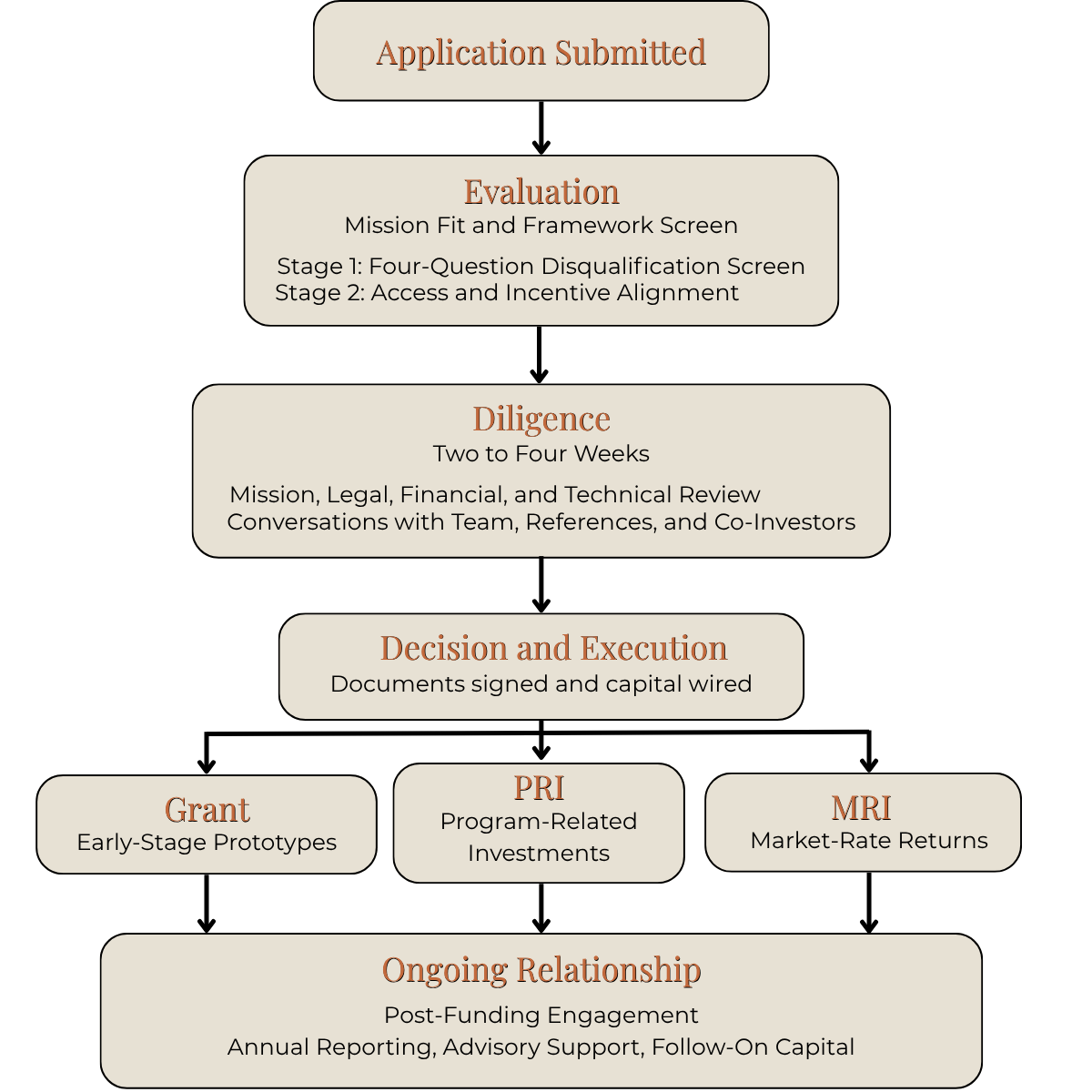
The instrument is chosen based on mission alignment and financial viability. Weak mission alignment results in pass, regardless of financial strength.
WHAT WE DONT FUND
X
Models dependent on government procurement or policy change to scale
X
Religious organizations or programs requiring religious affiliation
X
Pure service delivery without a capability-development mechanism
X
Models where value creation only occurs after the learning is complete
X
Programs requiring selective admission or prior credentials to participate